





The Social Systems Division addresses the challenges of social systems to realize the future vision that human socioeconomic activities, the root of environmental problems, will be sustainable for both the environment and human society.
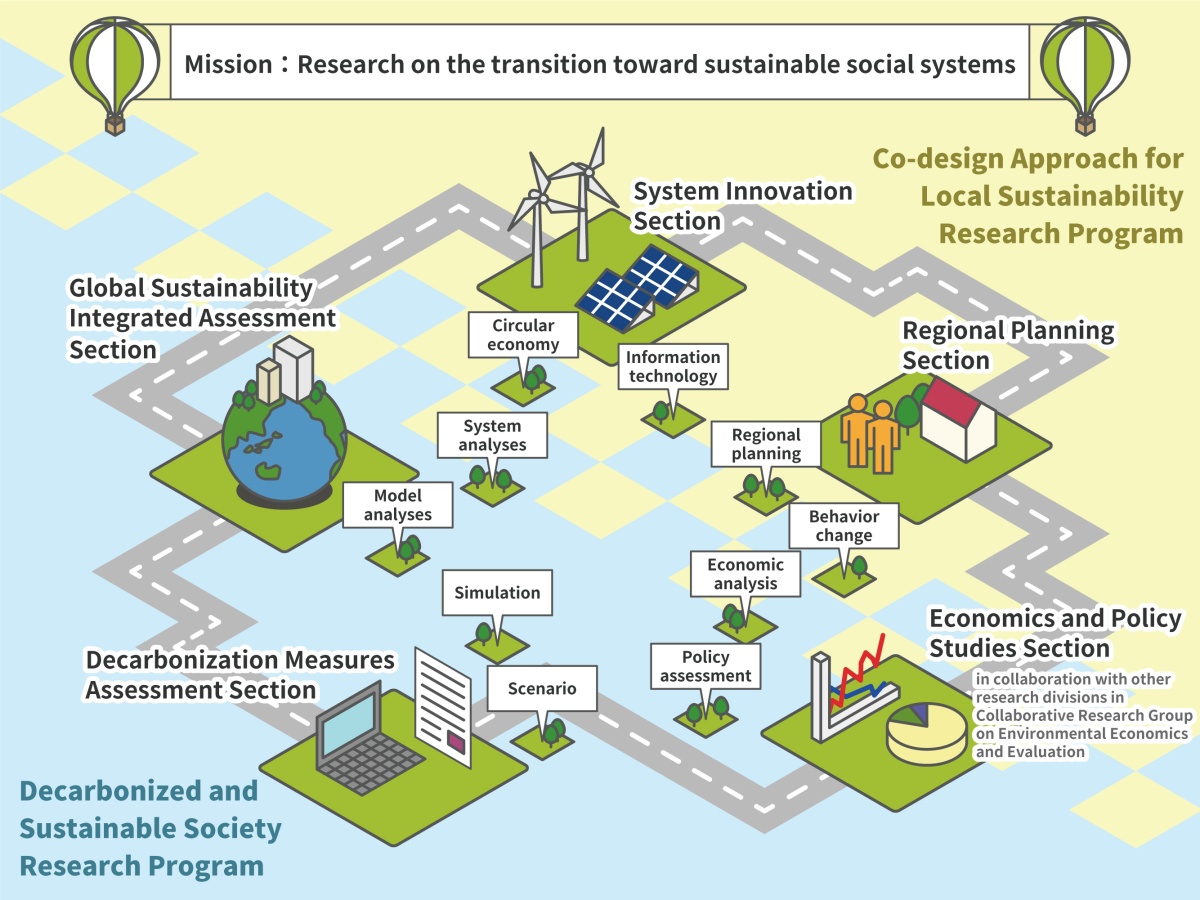
Five Sections
The Social Systems Division consists of the following five sections.
-
Integrated Sustainability Assessment SectionResearch on the development and application of integrated assessment models to advance sustainable transitions by addressing cross-cutting environmental and social challenges across global, national, and regional scales, and by evaluating environmental, economic, and social systems.
-
Decarbonization Measures Assessment SectionResearch on development of models and databases for assessing decarbonization initiatives for tackling climate change problems.
-
System Innovation SectionResearch on sustainable use of energy and resources, including the development of measures for substantial improvement of their utilization efficiencies. LCCN (Life Cycle Carbon Neutral) is one of the research themes we are focusing on.
-
Regional Planning SectionResearch on lifestyle and regional planning for balancing environment and quality of life in urban and rural communities.
-
Economics and Policy Studies SectionResearch on environmental policy assessment, as well as theoretical research on environmental evaluation and methodological developments in the field of economics.
Accelerating Systems Change Research Program
National Institute for Environmental Studies (NIES) promotes research from a cross-disciplinary and integrated perspective on priority issues that require focused attention across research fields. Many researchers in the Social Systems Division participate in the “Research Program for Accelerating Systems Change towards Carbon Neutrality, the Circular Economy, and a Nature-Positive future,” which is one of the there strategic research programs of NIES.
Research Project on the Emergence and Implementation Strategies of Social Transformation
The “Research Project on the Emergence and Implementation Strategies of Social Transformation through Regional Collaboration(TBC),” contributed by the Social Systems Division, conducts research in collaboration with local stakeholders to address regional challenges and enhance sustainability. Our research integrates practice and theory, advancing methods for collaborative problem-solving and contributing to the development of collaboration studies.