

Reduced air pollution from climate mitigation could boost crop yields and lower hunger risk
Climate change threatens global food security; however, climate mitigation policies may increase hunger risk by driving competition for land through bioenergy production and afforestation. Based on simulations from six global agroeconomic models, researchers from The University of Tokyo, Ritsumeikan University, Kyoto University, National Institute for Environmental Studies, and E-Konzal Co. Ltd., together with collaborators from other countries, report that the ozone reduction benefits of climate mitigation could partially offset this increase in hunger risk.
1. Baseline changes in global hunger risk
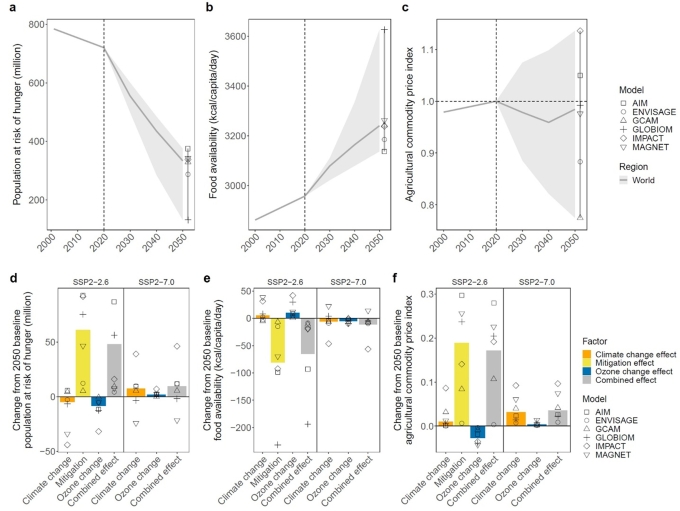
The baseline scenario assumes that today’s climate and air pollution conditions persist and follow SSP2 socioeconomic settings, a “middle-of-the-road” development pathway with moderate population growth and social, economic, and technological trends that broadly follow historical patterns within each region. According to the multi-model median of the six global agroeconomic models, food availability will increase by 2050 in the baseline scenario, decreasing the global hunger risk. Compared with 2020, the number of people at risk of hunger will fall by approximately 390 million by 2050, reaching approximately 330 million by 2050 (Fig. 1a–c).
2. Climate mitigation increases hunger risk
Compared with the baseline scenario, the 1.5 °C climate target scenario (SSP2-2.6) introduces carbon pricing and other climate mitigation measures that substantially raise production and agricultural commodity prices (Fig. 1f), to a greater extent than in the warming scenario (SSP2-7.0). Consequently, food availability will decline (Fig. 1e), and the global population at risk of hunger by 2050 is projected to be approximately 56 million higher than the baseline (Fig. 1d).
3. Ozone reduction partially offsets the negative effects of mitigation
The same mitigation policies reduce the emissions of ozone precursors, leading to lower ozone concentrations and higher crop yields. These ozone-driven yield gains reduce food prices and increase food availability. Consequently, approximately 8.4 million of the additional people at risk of hunger (approximately 15% of the mitigation-induced increase) will be offset by ozone reduction in 2050.
4. Benefits are concentrated in regions with severe hunger today
Regionally, approximately 56% of the hunger-reducing effect of ozone decline occurs in Sub-Saharan Africa and India, where hunger is currently the most severe.
These findings show that jointly assessing climate change, climate mitigation policies, and changes in tropospheric ozone from mitigation allows for a more accurate understanding of the tradeoffs and offsetting effects embedded in climate mitigation. Although previous studies may have overestimated the negative impacts of climate mitigation on food security by neglecting the benefit of ozone reduction, this study confirms that stringent mitigation can still increase hunger risks if land use and price effects are not appropriately managed.
To implement climate policies that limit future increases in hunger risk, it is essential to look beyond greenhouse gas emissions and carbon balances alone and to explicitly incorporate food security impacts at the design stage of mitigation strategies.
5. Publication
【Title】
Ozone pollution reduction partially offsets the negative impact of climate mitigation efforts on global hunger
【Authors】
Shujuan Xia, Tomoko Hasegawa, Thanapat Jansakoo, Daniel Mason-D’Croz, Kazuaki Tsuchiya, Shinichiro Fujimori, Maksym Chepeliev, Marta Kozicka, Abhijeet Mishra, Willem-Jan van Zeist, Xin Zhao, Thijs de Lange, Thais Diniz Oliveira, Jonathan C. Doelman, Matthew Gibson, Petr Havlik, Mario Herrero, Ipsita Kumar, Yuki Ochi, Timothy B. Sulser, Marina Sundiang, Kiyoshi Takahashi, Jun’ya Takakura, Keith Wiebe
【Journal】
Nature Food
【URL】https://www.nature.com/articles/s43016-026-01322-3 (Connect to an external site)
【DOI】10.1038/s43016-026-01322-3(Connect to an external site)
6. Press Release Presenters
Social Systems Division,
National Institute for Environmental Studies
Shujuan Xia, Research Associate (current position: The University of Tokyo)
Kazuaki Tsuchiya, Senior Researcher
Junya Takakura, Senior Researcher
Social Systems Division, Director
Takahashi Kiyosi
Research Organization of Science and Technology,
Ritsumeikan University
Tomoko Hasegawa, Professor
Graduate School of Engineering, Division of Environmental Engineering
Kyoto University
Shinichiro Fujimori, Professor
E-Konzal Co. Ltd.
Yuki Ochi, Principal Researcher
7. Contacts
【Expert Contact】
Social Systems Division
National Institute for Environmental Studies
Kazuaki Tsuchiya Senior Researcher
【Contact for the press release】
Public Relations Office, Planning Division
National Institute for Environmental Studies
Email: kouhou0 (please append ‘@nies.go.jp’ to complete the email address)