

New approach narrows uncertainty in future warming and the remaining carbon budget for 2℃
1. Background and research motivation
How much the planet warms with each ton of carbon dioxide remains one of the most important questions in climate science, but there is uncertainty in predicting it. This uncertainty hinders governments, businesses and communities from setting clear emission-reduction targets and preparing for the impacts of climate change. The changes in atmospheric carbon dioxide concentrations and surface temperatures are shaped by complex feedback between land, ocean, atmosphere and ecosystems, and this feedback can either amplify or mitigate warming. Reducing this uncertainty is critical to keeping the international goal of limiting warming to 2 °C within reach.
2. Methods
The team of researchers in Japan has developed an innovative approach to improve projection accuracy by combining climate model projections with observational data. The analysis was conducted using the results of numerical experiments on 20 state-of-the-art Earth System Models note 1 that participated in the Coupled Model Intercomparison Project (CMIP5 and CMIP6), which contributed to the Fifth and Sixth Assessment Reports of the Intergovernmental Panel on Climate Change (IPCC).
The team examined not only how climate models respond to rising carbon dioxide concentrations but also how human carbon dioxide emissions affect atmospheric carbon dioxide concentrations — a process governed by the Earth’s carbon cycle. This involves how much of the emitted carbon dioxide remains in the atmosphere versus how much is absorbed by forests, soils and oceans.
3. Results
The analysis revealed that many models overestimate global warming relative to past carbon dioxide emissions. By bringing observations into the picture, the researchers narrowed the uncertainty in projected 21st-century warming and refined estimates of the remaining carbon budget—the total carbon dioxide that can still be emitted while keeping warming level below 2℃.
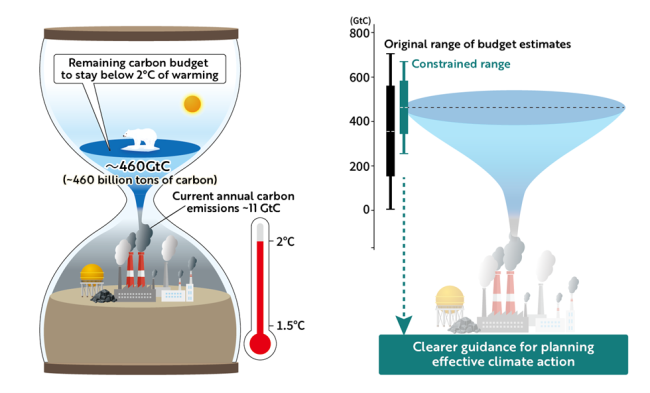
Previous studies that did not account for the degree of agreement with observations estimated the remaining carbon budget for limiting warming to 2℃ at about 352 billion tons of carbon, with a wide uncertainty range of 2–702 billion tons note 2. By taking into account the degree of agreement between the Earth system model and observations, the analysis refined this estimate to a mean of 459 billion tons with a narrower uncertainty range of 251–666 billion tons, thereby substantially improving projection accuracy (Figure 1).
Figure 2 illustrates how taking into account the degree of agreement between model results and past observations leads to more accurate projections. In climate research, models that better reproduce the observed global temperature rise (horizontal pink bar) are considered more reliable for future predictions note 3. By giving greater weight to such models, the analysis reduces the spread of estimates for the remaining carbon budget (vertical green bar) compared with the full model range (vertical black bar), thereby improving prediction confidence.
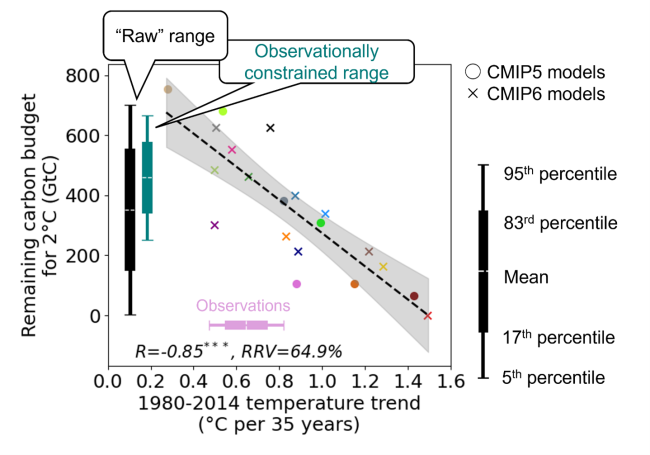
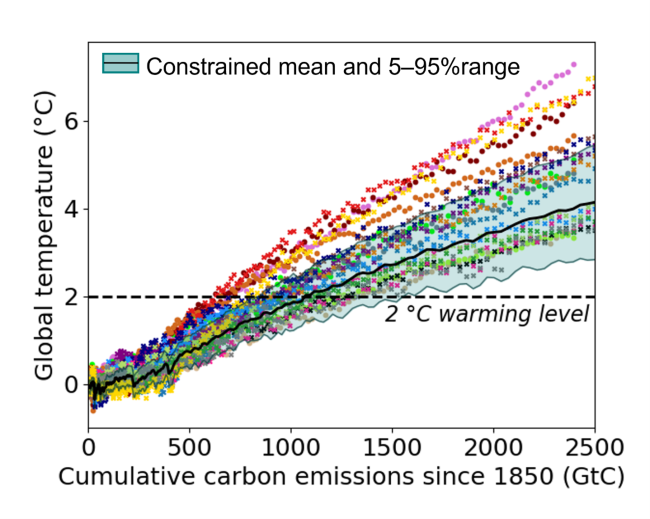
This study sheds light on why estimates of future warming shift when emissions are used instead of concentrations. In the real world, not all of the carbon dioxide we emit stays in the air — much of it is absorbed by forests, soil and oceans. How models represent this “airborne fraction” and the split between land and ocean sinks strongly influences their projections. In many simulations, models warmed the planet too quickly and underestimated how much carbon the land and oceans could take up. By comparing these processes with observations, the researchers showed that some of the most extreme warming projections are less likely, which tightens the range of outcomes (Figure 3). Previous studies have not been able to improve the accuracy of Earth system models’ predictions of both land and ocean carbon dioxide uptake and temperature change. This study is the first to achieve such improvement using the approach illustrated in Figure 2.
4. Prospects
These results strengthen the scientific foundation for climate policy by narrowing the range of future warming and the remaining carbon budget. More reliable projections give governments clearer guidance for setting emission-reduction targets, reinforce the credibility of net-zero pledges, and help communities prepare for climate impacts. Beyond the immediate policy relevance, the new framework also offers a valuable tool for future climate assessments, including the upcoming IPCC AR7, where it can be extended to other components of the Earth system.
Yet the broader message is one of urgency: even with refined estimates and a somewhat larger remaining carbon budget, current emissions of about 11 billion tons of carbon per year would still deplete the budget for limiting warming to 2 °C within just a few decades. Our results demonstrate the imperative to take urgent action to reduce greenhouse gas emissions.
5. Annotations
Notes
1 Earth System Models are advanced computer simulations that capture the complex interactions among the atmosphere, ocean, land, and biosphere. They are essential for understanding how human activities affect the planet, reconstructing past environmental changes, and projecting future climate conditions. Models developed under the international Coupled Model Intercomparison Projects (CMIP5 and CMIP6) played an important role in the IPCC’s Fifth and Sixth Assessment Reports.
2 The uncertainty range of future projections indicates the range that covers most results. Specifically, it indicates the range of predictions that corresponds to the bottom 5% to the top 5% of predictions obtained by multiple Earth System models.
3The method used in this study, emergent constraint, aims to reduce uncertainties in future climate projections. It relies on statistical relationships that link differences in models’ historical behavior to their future projections and compares these relationships with observations to refine the uncertainty range.
6. Funding
Program for the Advanced Studies of Climate Change Projection (SENTAN, grant number JPMXD0722681344) from the Ministry of Education, Culture, Sports, Science and Technology of Japan, the Environment Research and Technology Development Fund (JPMEERF20242001) of the Environmental Restoration and Conservation Agency and the Ministry of Environment of Japan, KAKENHI (JP24K20979) of the Japan Society for the Promotion of Science
7. About the article
【Article Title】Narrowed uncertainty in future global temperature and remaining carbon budget
【Authors】Melnikova I., Yokohata T. & Shiogama H.
【Journal】One Earth
【URL】https://doi.org/10.1016/j.oneear.2025.101526
【DOI】10.1016/j.oneear.2025.101526
8. Author of this press release
National Institute for Environmental Studies
Earth System Risk Analysis Section, Earth System Division
Melnikova Irina
Yokohata Tokuta
Shiogama Hideo
9. Contact Information
【Contact for this research】
National Institute for Environmental Studies
Earth System Risk Analysis Section, Earth System Division
Melnikova Irina
Yokohata Tokuta
Shiogama Hideo
【Contact for this research】
National Institute for Environmental Studies
Public Relations Office, Planning Division
E-mail: kouhou0 (please append ‘@nies.go.jp’ to complete the e-mail address)