Health and Environmental Risk Division
Director
Director of Health and Environmental Risk Division
YAMAMOTO Hiroshi
Greetings
As we pursue a healthier and more comfortable life (“well‑being”), new high‑function chemicals continue to be developed. At the same time, society is shifting from mass production and mass consumption to producing many types of chemicals in smaller quantities. This makes it increasingly difficult to grasp the full picture of chemical pollution.
While traditional concerns—such as heavy metals like mercury, airborne particles, pesticides, and surfactants—remain important, new issues that span across multiple environmental media such as air, water, and soil have also emerged. Examples include:
- PFAS (Per‑ and Polyfluoroalkyl Substances), a group of more than 10,000 chemicals;
- Plastics, tires, and their degradation products, which we use in enormous quantities;
- Antimicrobial resistance (AMR) caused by disinfectants and antibacterial agents.
All of these raise concerns for both human health and ecosystems.
Thanks to advances in analytical instruments, we can now detect extremely low concentrations of many chemicals. Yet each chemical has different types of hazards. In particular, many substances can disrupt biological systems such as the endocrine, nervous, and immune systems even at very low concentrations. At the same time, increasing restrictions on animal testing—driven by animal‑welfare considerations—make it more challenging to obtain toxicity data.
In response to these global challenges, international efforts have accelerated. In 2023, the United Nations adopted the Global Framework on Chemicals (GFC), a new global structure for chemical management. In addition, following the IPCC (climate change) and IPBES (biodiversity), a new Intergovernmental Science–Policy Panel on Chemicals, Waste and Pollution (ISP‑CWP) was established in 2025. These initiatives highlight the growing importance of using scientific evidence to support policy decisions in chemical safety.
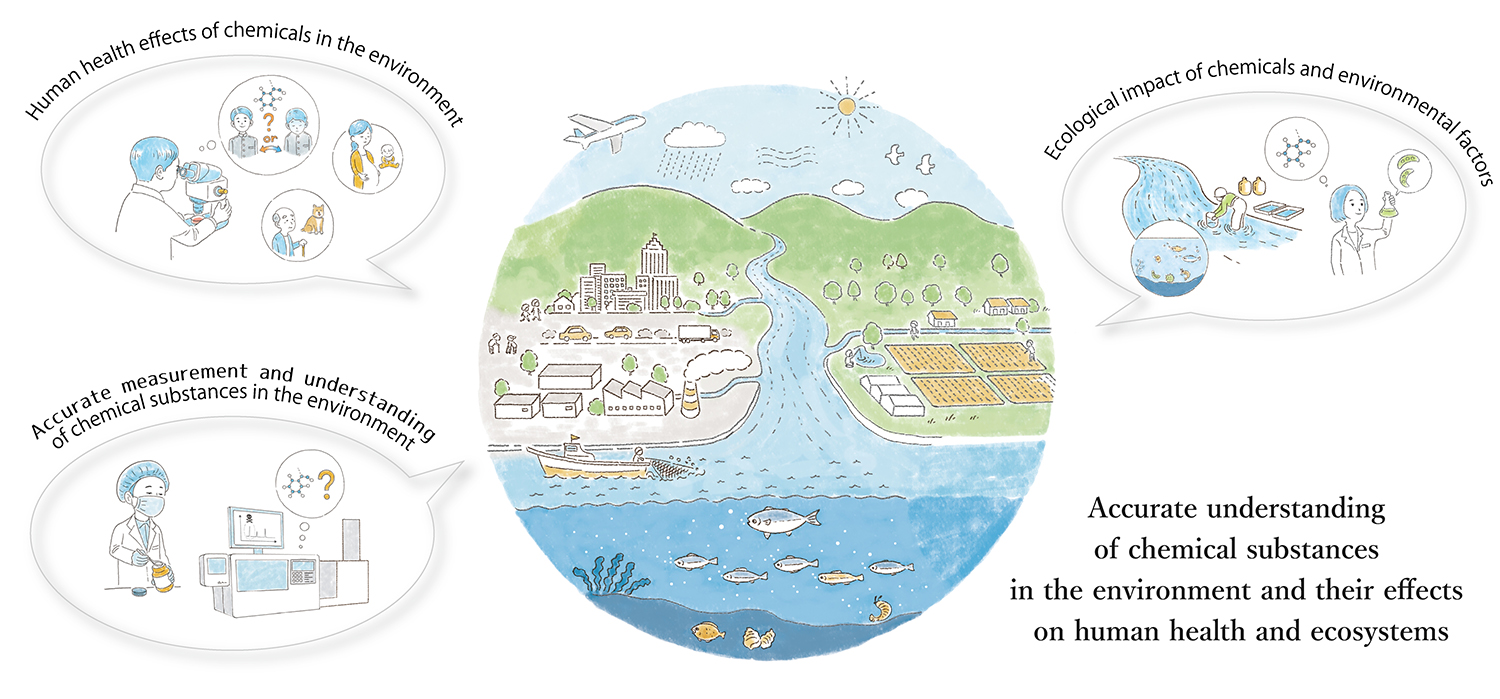
To address these emerging challenges, the Health and Environmental Safety Research Domain is launching a new initiative under its 6th Medium‑ to Long‑Term Plan, starting in fiscal year 2026. In addition to fundamental and foundational research, the program will advance policy‑oriented studies through the newly established Research Center for Environmental Regulatory Science, which works in collaboration with the Ministry of the Environment and international organizations to help translate scientific knowledge into real‑world policy solutions. Within this framework, the program operates the Safety Assurance Research Area, jointly implemented with the Regional Environmental Conservation Division.
This research area also plays a key role in the Health and Environmental Safety Research Project, which focuses on developing hazard‑assessment methods that respect animal welfare and on evaluating the hazards and risks of chemical substances that are unknown, poorly understood, or not yet regulated. Through these efforts, the program aims to support society in managing chemical risks more effectively and responsibly, while ensuring that scientific evidence is appropriately reflected in future environmental policies.
In addition, our program plays a central role in a cross‑cutting research initiative titled “Research Program for the Comprehensive Assessment and Solutions of Emerging Human and Ecosystem Threats from Cross Media Environmental Pollution”, which aims to comprehensively understand and address new threats to humans and ecosystems arising from environmental pollution that spans multiple media—such as water, air, and soil—including PFAS, plastics, and antimicrobial resistance (AMR). We also participate in the research program “Implementing and Expanding Nature‑based Solutions (NbS)”, which promotes the use of natural processes and ecosystems to support environmental management and sustainable development.
Furthermore, several key research facilities that support environmental science through the development of (certified) reference materials and advanced measurement technologies are also part of this program. These include the “Center for Environmental Standards and Measurement”, the Japan Environment and Children's Study Programme Office, which plays a central role in the Ministry of the Environment’s nationwide “Japan Environment and Children’s Study (JECS),” and the “Wako Branch Office” for drinking water quality research, which will be transferred from the Ministry of Health, Labour and Welfare in fiscal year 2025 to strengthen research on drinking‑water safety. Working together as an integrated system, these centers will continue to advance research that contributes to public safety, well‑being, and the protection of ecosystems.