The Lancet MedZero: a single platform for carbon data across every product in healthcare
Launching today at the 79th World Health Assembly with more than 14,000 entries across all of healthcare, the first global database of its kind.
GENEVA, 20 May – If healthcare was a country, it would be the fifth largest carbon emitter on the planet – between the European Union and the Russian Federation, with CO2 emissions in the sector higher than all of aviation and shipping combined.
Yet, until today, carbon data has been available for less than 1% of the products a clinician or a health system uses each day.
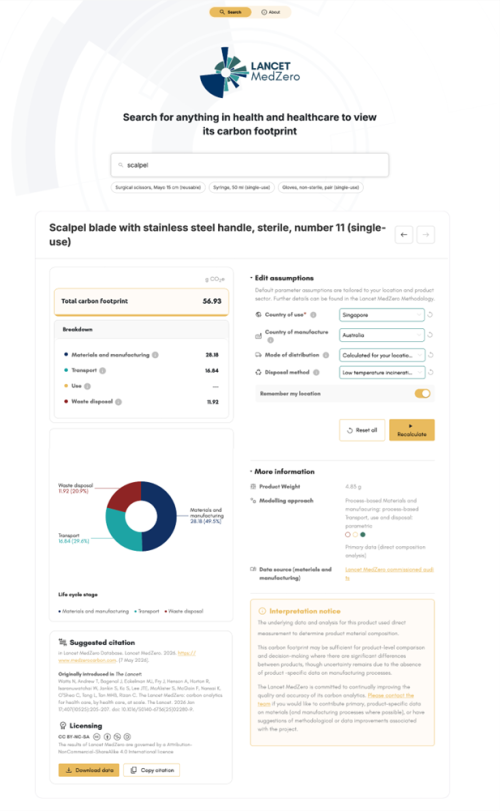
The Lancet MedZero is built to close that gap. Launching today at the 79th World Health Assembly, the platform (www.medzerocarbon.com) is the first to provide comprehensive carbon analytics across the full spectrum of healthcare, from pharmaceuticals and surgical instruments to chest X-rays and blood tests.
Convened by The Lancet and developed by an international academic consortium, it has been designed by clinicians, for clinicians, with over 14,000 entries at launch.
The platform is built to inform decisions at every level of the health system with the aim of helping hospitals and clinics save money, reduce waste, improve patient care, and tackle climate change. For example:
-
A health policymaker in the UK could identify that a simple switch from polluting incineration to recycling would avoid over 311,000 tonnes of CO2e (the equivalent to taking 212,000 British cars off the road), saving 76 million GBP each year as a result.
-
A hospital CEO in Singapore, can see transitioning to reusable surgical gowns would reduce CO2e emissions by 4,407 tonnes (equivalent to the annual electricity use of 3,159 HDB households in Singapore), saving around 700,000 SGD annually.
-
And national procurement experts across the world can compare logistics alternatives, saving over 3.85 million tonnes of CO2e by shifting to lower-carbon freight options for pharmaceuticals, such as shipping, globally (equivalent to nearly twice the national emissions of Malta).
The platform’s launch at the World Health Assembly brought together the Editor in Chief of The Lancet, the Minister of Health of the Philippines, the International Medical Secretary for Doctors Without Borders, the UK NHS’s Chief Sustainability Officer, and the Permanent Secretary of the Thailand Ministry of Public Health.
“The climate crisis is a health crisis. But climate action depends on credible data.” Dr Richard Horton, Editor-in-Chief of The Lancet, said ahead of the launch, “The Lancet MedZero plans to create a shared global infrastructure of knowledge about the carbon footprint of health systems. Measurement is the foundation of accountability, and accountability is the motivation for action.”
1Carbon analytics, volume, and cost data drawn for each of the three examples from www.medzerocarbon.com and underlying data sources.
The problem the Lancet MedZero solves
More than 100 countries, covering over half the world’s population, have now committed to tackling climate change through a WHO-led Alliance for Transformative Action on Climate and Health.
Until now, that data has been fragmented and inaccessible. The Lancet MedZero was built to change that.
For their hospitals and health systems to turn those commitments into action, they need transparent and trustworthy data to make evidence-based decisions. A surgeon redesigning a care pathway, a pharmacist restocking a hospital supply, a procurement lead renegotiating supply contracts, and a health minister setting national strategy: all of them need product-level carbon data, quickly and reliably.
A global collaboration built for scale
The Lancet MedZero is a global collaboration of clinicians, engineers, data scientists, economists, and public health professionals working to support healthcare decarbonisation worldwide. Convened by The Lancet, it brings together expertise in healthcare delivery, carbon analytics, and system transformation, with contributors from across Asia-Pacific, Europe, and North America. This diversity reflects a shared commitment to advancing sustainable healthcare across regions.
Academic partners: Health Intervention and Technology Assessment Program (HITAP), Thailand; National Institute for Environmental Studies (NIES), Japan; National University of Singapore; Northeastern University, USA; University of Birmingham, UK; University of Melbourne, Australia
About The Lancet: The Lancet is one of the world’s leading medical journals, published since 1823. It has a long-standing commitment to climate and health, including through the Lancet Countdown, the Lancet Commission on Sustainable Healthcare, and multiple commissions on planetary health, pollution, among others.
Contact
Learn more about the platform at https://medzerocarbon.com.
For media enquiries, contact Ms Jit Sohal (info@lancetmedzero.com & +6580950307)
ANNEX: Preview of the Lancet MedZero in Action