The World of Protozoa, Rotifera, Nematoda and Oligochaeta
Trichotria
Trichotria Bory de St. Vincent, 1827
Order Ploimida: Family Trichotriidae (ref. ID; 7097)
Synonym Dinocharis Ehrenberg, 1830 (ref. ID; 1345, 1923, 2978, 3514, 3688)
ref. ID; 1663
Lorica composed of one box-like piece, usually thick and with large facets. Usually with two spines at base of foot, or rarely with two posterior dorso-lateral spines on the lorica. Mastax malleate. (ref. ID; 1663)
The stomach always contained remains of blue-green algae and some yellow-brown pigment of unknown origin. (ref. ID; 1511)
The lorica is comparatively long and not very wide, with a jutting edge along the dorsal surface of the lorica. The foot is 3 segmented and withdrawn in contracted specimens. Two main toes long with pointed ends. In between these two toes is a small spine which is characteristic. (ref. ID; 2715)
Measurements
Total length 200 µm. (ref. ID; 2715)
Length of lorica (head retracted) 125; width of lorica 80; length of toes 125 µm. (ref. ID; 3275)
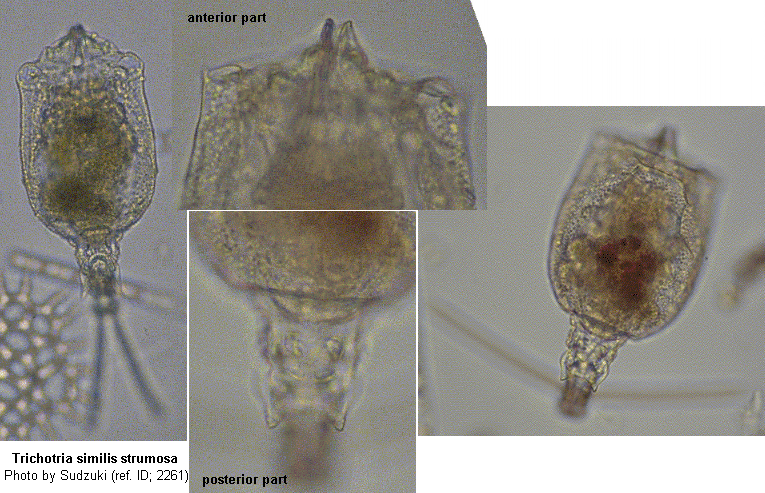
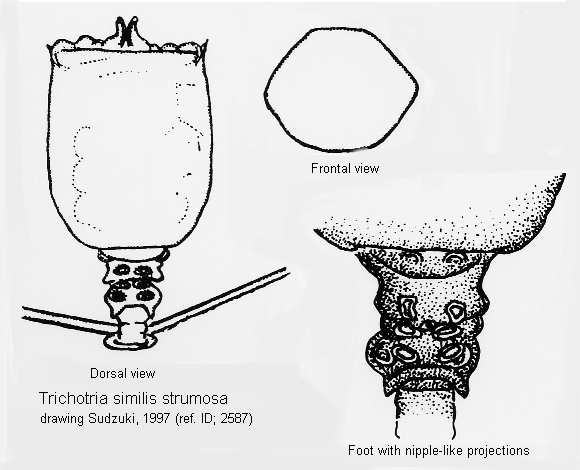
This species had the closest relation to similis Stenroos, 1898 in 1) having a pair of long a straight toes, 2) lacking long and curved spines on the foot, 3) lacking serrations on both lateral sides of lorica, 4) lacking long lateral spines on the frontal margin. It differs from the specimens of both Stenroos (1898) and Fadeew in having 1) short and thick trunk, 2) several nipple-like projections on the foot. Besides, in this species the pectoral margin is two-lobed as in Brachionus budapestinensis and two pairs of small projections are recognized on the dorsal side of the head. Dinocharis similis Stenroos, 1898 was treated as Trichotria similis Stenroos by Harring (1913), Wiszniewski (1953) and Voigt (1957), while, Weber and Montet (1918) classified it as Dinocharis tetractis similis, Stenroos; Koste (1976) as Trichotria tetractis similis, Stenroos. In the Sudzuki's opinion, tetractis and similis are different are the species level in the morphology of the foot. (ref. ID; 2587)
Antero-lateral margins of the lorica pointed. Dorsum with usual carinal plates and ridges. Lorica and foot joints pustulated. First foot joint with a pair of dorsal spines. (ref. ID; 1929)
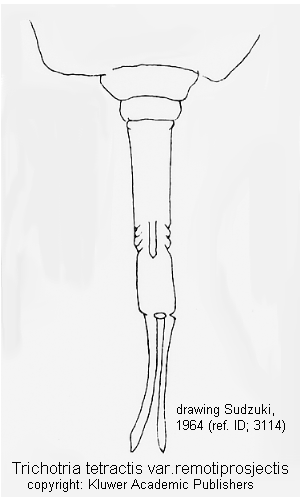
Foot with 3 segments, the first segment bearing two dorsal triangular spines. The second segment of the foot is longer than the other two. Toes long slender ending in a point. (ref. ID; 2715)
The side-parts of the shell are with or without denticles. Nearly every specimen shows different measurements and also different dorsal and ventral ornamentations of the shell. The length of the foot segments and also of the toe vary. This shows a very broad variation in the morphological and taxonomical characteristics the limits of which must be investigated more thoroughly. (ref. ID; 2834)
Lorica longer than its width, foot three segmented with two dorsal triangular spines, second foot segment longer than others. Toes long slender. (ref. ID; 2867)
Lorica vase-shaped, facetted, slightly narrowing posteriorly. Foot and toes long. No spine between toes. First segment of foot bearing two wide spines. (ref. ID; 3180)
Comments
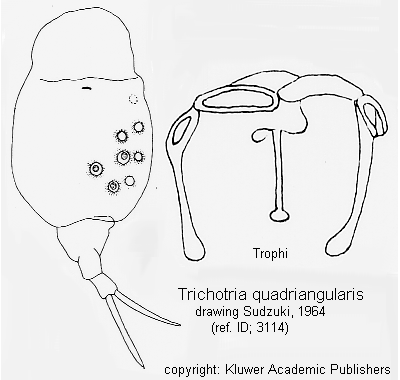
As Carlin (1939, p.40) has accounted for all the transitional stages between T. tetractis, T. similis Stenroos and T. quadrangularis Stirnimann, there seems to point in retaining the last two species any longer. (ref. ID; 1450)
This species appears to favour acid waters, whereas T. pocillum is usually found in eutrophic, alkaline water. (ref. ID; 3208)
Measurements
Total length of the body 294; first foot joint 56; length of toes 84; length of lorica 126; width of lorica 70 µm. (ref. ID; 1929)
Lorica length 115; length of foot 70; toes 90 µm. (ref. ID; 2704)
Length of lorica 114; width 96; foot 69; toe 90 µm. (ref. ID; 2715)
Length of lorica 120-130; length of toes 100-108 µm. (ref. ID; 2825)
Total length (with contracted head) 290-392; shell width 90-110; toe length 92-120 µm. (ref. ID; 2834)
Total length 160; toes 80 µm. (ref. ID; 2867)
Length of body 200; length of foot 70; length of toes 100 µm. (ref. ID; 3127)
Length of body (head retracted) 120; width of body 55; length of toes 82 µm. (ref. ID; 3275)
Trichotria tetractis var. turfacea Petr., 1890 (ref. ID; 3688)
Synonym
Dinocharis tetractis caudata Lucks, 1912 (ref. ID; 3036); Dinocharis tetractis caudata n. var. Rodewald, 1935 (ref. ID; 3036)
Descriptions
Normally the elongated termination of the posterior dorsal end of the lorica is directed obliquely upwards and also backwards, and only rarely are specimens found in which this termination is bent upwards. (ref. ID; 3036)
Comments
In 1912 Lucks described a new variety form West Prussia as follows: '... die sich hauptsachlich durch eine eigenartige Verlangerung des Panzer-hinterrandes, in Form eines aufgebogenen Stummelschwanzes, ausgezeichnete...'. After more than twenty years Rodewald describes a new variety from Bukovina giving it the same name as had previously been used by Lucks, namely Dinocharis tetractis var. caudata. The description and drawings of these, under the same specific and varietal classification, agree perfectly with the form discovered and described by Lucks many years before. (ref. ID; 3036)
Measurements
Length of lorica 150-180; length of toes 52-65 µm. (ref. ID; 3036)
Length of body 110; width 90; foot 45; toes 90 µm. (ref. ID; 2280)
Total length of lorica 130; width of lorica 110; length of foot 50; length of toes 90 µm. (ref. ID; 3127)
Small Trichotria with a blunt thorn on the corner of the anterior margin of the lorica. The ventral lorica is smooth, the dorsal has some folds. Posterior margin of the lorica is rounded, with no prolongation or thorn. Foot without thorn with 2 very well developed segments. Typical are the strong toes which are bent like a sickle. (ref. ID; 4604)
Type locality
Some individuals at Mt. Paparoa. (ref. ID; 4604)
Measurements
Total length 160; lorica length 90; lorica width 66; frontal margin width 60; foot length 12 + 16; toe ca. 40 µm. (ref. ID; 4604)